Minister of Women’s Affairs at High-Level UN Roundtable: “Investing in Palestinian Women Is an Investment in Resilience, Recovery and Peace”.
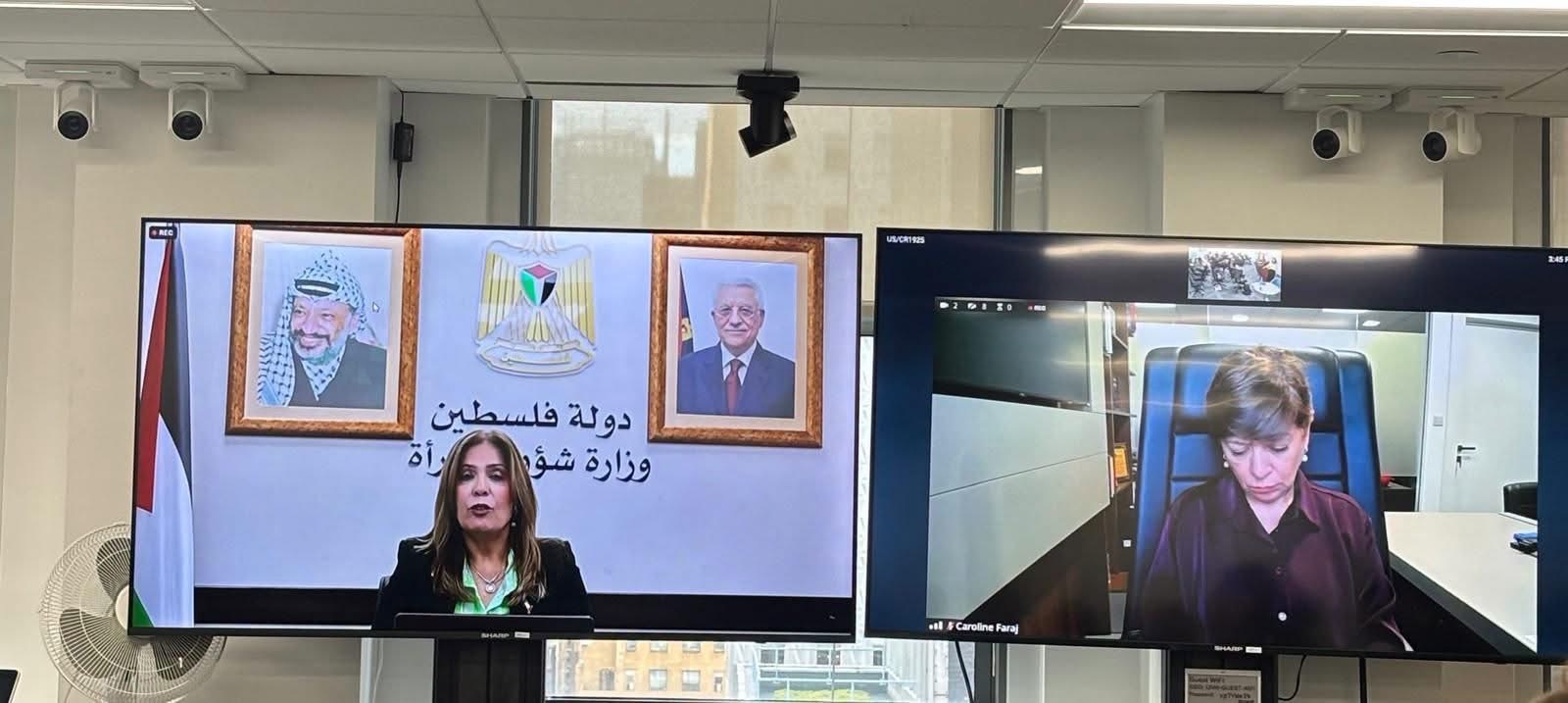
On the sidelines of the high-level week of the 81st session of the United Nations General Assembly, Minister of Women’s Affairs Ms. Mona Al-Khalili delivered the State of Palestine’s statement at a high-level roundtable launching the Strengthening Women’s Employment Initiative in the Middle East and North Africa (SWEI). The event was jointly organized by UN Women and the European Union and held at UN Women’s headquarters in New York.
The high-level roundtable brought together European Commissioner for the Mediterranean Dubravka Šuica,senior UN Women officials; Ambassador Amr El-Sherbini, representing the Egyptian government, Julie Delahanty, President of Canada’s International Development Research Centre, Issa Faye, Director General at the Islamic Development Bank, and Noura Al Suwaidi, Secretary-General of the UAE General Women’s Union. Representatives of the Spanish Agency for International Development Cooperation (AECID), the Organization for Economic Co-operation and Development (OECD), the private sector, international financial institutions and development partners also participated.
The SWEI initiative aims to drive a regional shift in women’s employment across the Middle East and North Africa through policy reform, strategic investment, innovative financing and stronger partnerships with the private sector and international financial institutions. It seeks to create decent, sustainable employment opportunities for women, particularly in the care economy, the green economy, and science, technology, engineering and mathematics (STEM) fields.
Al-Khalili reaffirmed the State of Palestine’s commitment to strengthening women’s economic participation and employment despite the exceptional and difficult circumstances facing the Palestinian people. She noted that the ongoing Israeli military offensive and the widespread destruction it has caused in Gaza Strip, together with escalating restrictions and violence in the West Bank, have led to extensive economic losses, destroyed livelihoods, productive assets, and reduced employment opportunities, whereas women and girls have been among those most affected in the repercussion of the aggression.
“Palestinian women need more than recognition of their resilience. That resilience must be met with opportunities, investment and rights,” Al-Khalili said. She emphasized that, despite harsh and deteriorating conditions, Palestinian women continue to work, produce and innovate, helping to support their families and sustain the cohesion of their communities.
The Minister presented indicators on Palestinian women’s participation in the labour market. She said that unemployment among women in the Gaza Strip had reached approximately 92%, rising to 94% among young women. Meanwhile, in the West Bank, women’s labourforce participation stood at 17.9% in the second quarter of 2026, while unemployment among young female graduates exceeded 51%.
In this context, Al-Khalili affirmed the State of Palestine’s readiness to join SWEI and contribute actively to its implementation. This is based on all national efforts and applied research identifying promising sectors with the potential to expand women’s employment, particularly the care economy and STEM fields, alongside the green economy and productive sectors capable of creating sustainable jobs for women and young women.
Al-Khalili called on the European Union, UN Women, international financial institutions, development partners, donors and the private sector to move beyond supporting isolated initiatives and invest in a scalable Palestinian model for women’s economic empowerment and employment. Such a model would connect skills development with access to finance, support women-led businesses and enterprises, link them to markets and value chains, and encourage the private sector to create decent jobs for women and young women in promising sectors.
She emphasized that Palestine has a practical foundation that can be built on and expanded through SWEI, enabling proven models to be scaled up and international financing to be linked directly to measurable indicators. These include the number of jobs created for women and young women, the proportion entering promising sectors, the sustainability of women-led businesses, and increased women’s participation in the labour market.
Al-Khalili stressed that the next phase requires a long-term investment partnership that places Palestinian women’s employment at the heart of efforts to strengthen resilience, support recovery and advance reconstruction. She affirmed the Ministry of Women’s Affairs’ readiness to work with international partners to develop a dedicated financing and investment mechanism directed for women, through which resources could be mobilized and directed towards programmes and scalable models that create jobs.
The Minister concluded by emphasizing that investing in Palestinian women is more than a social response, it is an investment in the Palestinian economy, an investment in resilience today, in recovery tomorrow, and in the foundations of a just and lasting peace.
Related topics
- Alkhalili reviewed the results of the efforts implemented by the Ministry of Women’s Affairs during 2024 – 2026 and identify the priorities of the coming period.
- The Deputy Minister of the Ministry of Women's Affairs, Ms. Buthaina Al Salem, participated in the regional workshop on capacity building for data systems and evidence-based monitoring.
- AlKhalili: International Commitments to Palestinian Women Must Translate into Protection, Accountability and Concrete Action
- The minister of Women’s Affairs meets with the General Secretary of the International Trade Union Confederation and discusses the conditions of Palestinian working women and ways to enhance their rights.
- The minister of Women’s Affairs welcomed the representative of Finland to the State of Palestine and discuss joint cooperation
- Al Khalili and Abu Hamda emphasize the importance of integrated efforts to enhance the resilience and empowerment of women in Qalqilya Governorate.
- The Ministry of Women's Affairs discusses with women's organizations enhancing women's resilience and expanding their participation.
- The Minister of Women's Affairs and the honorable Governor of Qalqilya visit the Ajyal Association for the Care of the Elderly.
- The Ministry of Women's Affairs and the Governor of Qalqilya Governorate meet with local councils in Seniria, Izun Atma, and Beit Amin to discuss their needs and strengthen women's resilience.
- The Ministry of Women's Affairs and "Reform" launch the National Feminist Policy to enhance the resilience of Palestinian women in the context of the occupation.