AlKhalili: International Commitments to Palestinian Women Must Translate into Protection, Accountability and Concrete Action
The Minister of Women’s Affairs confirmed and ensured that the International commitments to Palestinian women must not remain mere words on paper, they must be translated into effective protection, accountability, and concrete action. Her Excellency emphasized that protecting and empowering Palestinian women and strengthening their leadership are interconnected pillars of the Palestinian people’s struggle for freedom, independence, and justice.
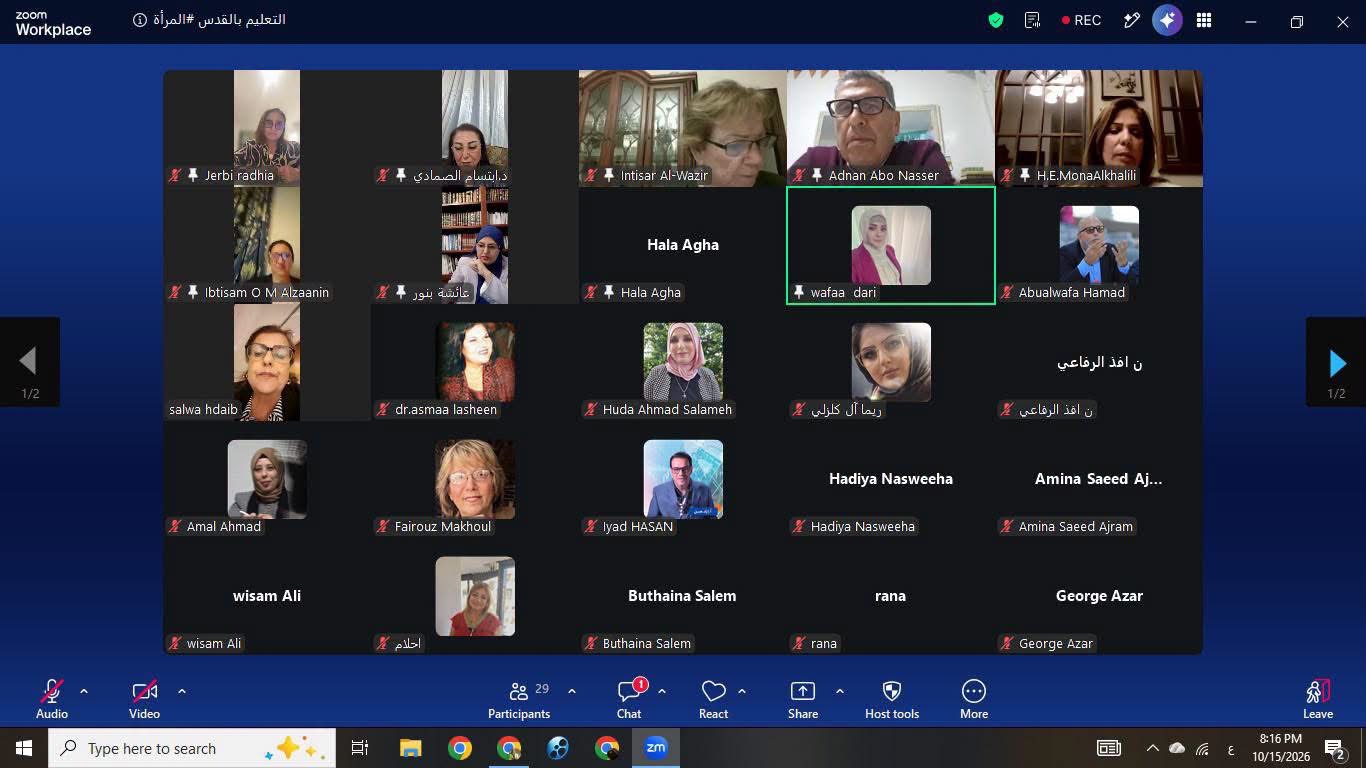
These remarks came during the participation of Her Excellency Ms. Mona Al Khalili, Minister of Women’s Affairs, on Thursday in the sixth international conference “Jerusalem Conference for Creative Women,” organized by the Palestinian International Creativity Foundation. She joined via video conference in an intellectual forum entitled “Creative Arab Women in the Knowledge, Civilizational, Cultural and National Spheres.”
The participants included Palestinian activist Ms. Intissar Al Wazir (Um Jihad), President of the General Union of Palestinian Women, lawyer Radya Jerbi, President of the National Union of Tunisian Women, Syrian poet and academic Dr. Ibtisam Al-Samadi, Prof. Wisam Ali Al Khalidi, Chair of the Seminars and Lectures Committee of the World Association for the Defence of the Arabic Language, Dr. Safaa Mokhtar, former President of the Arab Council for Culture and Heritage, Dr. Aisha Al Khadr, President of the Arab Union for Culture, Dr. Durria Farhat, a professor at the Lebanese University, Haneen Al Amsi, Executive Director of the Eyes on Heritage Foundation for Studies, Research and Publishing, and Algerian novelist and media professional Ms. Ayesha Benّour.
The Forum was opened by Ms. Salwa Hdeib, President of the Jerusalem Forum for Creative Arab Women, and moderated by Dr. Wafaa Dari.
Al-Khalili explained that the realities facing Palestinian women can’t be separated from the repercussions of the Israeli occupation, including violence, displacement and restrictions it imposes, along with its economic, social and psychological consequences. She emphasized that women and girls face compounded burdens arising from violations by the occupation, societal violence, poverty, unemployment, and responsibilities for providing for their families and caring for children. She stressed that there can be no genuine development under occupation, no sustainable empowerment of women without their protection, and no female effective participation in leadership without guaranteeing their rights and equal opportunities.
She noted that the Ministry of Women’s Affairs is working on strengthening the government’s role in protecting and empowering women and girls through three complementary tracks: protection, comprehensive empowerment, and international pressure and advocacy. In this context, she emphasized the importance of developing policies and legislation, strengthening the referral and protection system, and integrating the efforts of government institutions and civil society organizations to combat violence in all its forms and move from responding to cases after violence has occurred to preventing it and addressing its causes.
Regarding the empowerment, Al Khalili explained that the Ministry’s efforts aim to strengthen women’s participation in leadership and decision-making positions, expand their access to decent work, finance and markets, support small enterprises, and enhance their access to education, healthcare, social protection and technology. These efforts also include supporting women’s creativity, safeguarding Palestinian national identity and narrative, and challenging stereotypes that limit women’s presence and influence. She emphasized that Palestinian women must be genuine partners in planning, decision-making and setting national priorities, rather than merely beneficiaries of programmes and policies.
Regarding international pressure and advocacy, Al Khalili stressed the need to use international conventions and resolutions, foremost among them the Convention on the Elimination of All Forms of Discrimination against Women (CEDAW), United Nations Security Council Resolution 1325 and subsequent resolutions on women, peace and security, to strengthen international accountability, ensure humanitarian access, protect women and girls from violations, and support their participation in recovery, reconstruction and peacemaking efforts.
She called for stronger partnerships with women’s organizations, human rights organizations and international institutions, and for unified efforts and positions to bring Palestinian women’s voices to the world, in support of the Palestinian people’s rights to freedom, self-determination and the establishment of an independent state with East Jerusalem as its capital.
She also emphasized the importance of strengthening partnerships among the government, civil society organizations, the private sector and international partners, developing policies informed by evidence and sex-disaggregated data, allocating the necessary resources, and monitoring the impact of programmes on women’s lives. These efforts should ensure that women in Gaza Strip and the West Bank, including East Jerusalem, enjoy their rights and have access to opportunities, embed and integrate gender equality in government plans, policies and budgets, recognizing women’s issues as a shared national responsibility.
Al Khalili concluded by affirming that investing in Palestinian women is an investment in society’s resilience and its ability to recover and build a more just and equitable future. She stressed that women’s presence in leadership positions is not a privilege granted to them, but an inherent right and a national and developmental necessity. She affirmed that Palestinian women will remain essential partners in protecting society, safeguarding national identity, building institutions and shaping the future.
Related topics
- Alkhalili reviewed the results of the efforts implemented by the Ministry of Women’s Affairs during 2024 – 2026 and identify the priorities of the coming period.
- The Deputy Minister of the Ministry of Women's Affairs, Ms. Buthaina Al Salem, participated in the regional workshop on capacity building for data systems and evidence-based monitoring.
- AlKhalili: International Commitments to Palestinian Women Must Translate into Protection, Accountability and Concrete Action
- The minister of Women’s Affairs meets with the General Secretary of the International Trade Union Confederation and discusses the conditions of Palestinian working women and ways to enhance their rights.
- The minister of Women’s Affairs welcomed the representative of Finland to the State of Palestine and discuss joint cooperation
- Al Khalili and Abu Hamda emphasize the importance of integrated efforts to enhance the resilience and empowerment of women in Qalqilya Governorate.
- The Ministry of Women's Affairs discusses with women's organizations enhancing women's resilience and expanding their participation.
- The Minister of Women's Affairs and the honorable Governor of Qalqilya visit the Ajyal Association for the Care of the Elderly.
- The Ministry of Women's Affairs and the Governor of Qalqilya Governorate meet with local councils in Seniria, Izun Atma, and Beit Amin to discuss their needs and strengthen women's resilience.
- The Ministry of Women's Affairs and "Reform" launch the National Feminist Policy to enhance the resilience of Palestinian women in the context of the occupation.