Al Khalili during the launch of the "Reclaiming Space" and "Shaml" projects: Building a comprehensive national protection system that ensures no woman is left behind.
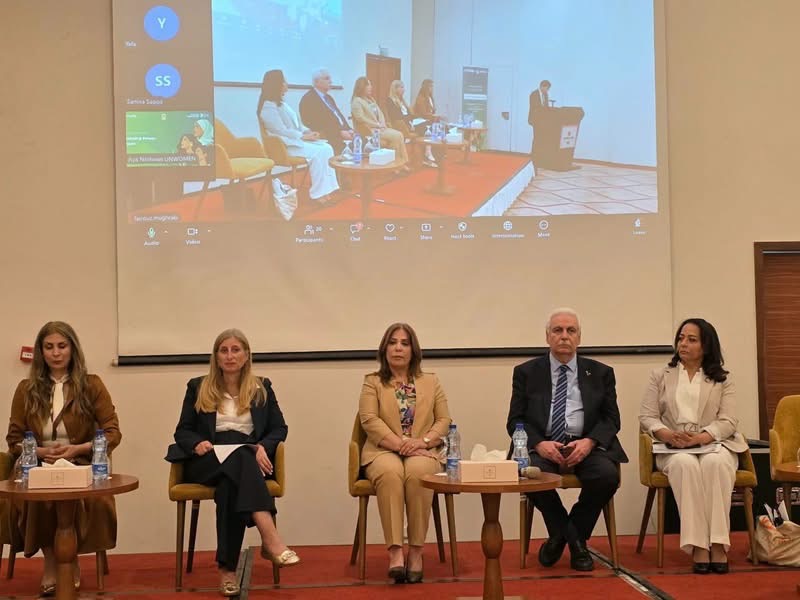
The Minister of Women’s Affairs Ms. Mona AlKhalili participated today, Wednesday, in the launch of the “Reclaiming Space” and “Shaml” projects, organized by UN Women in Palestine with the support of the Norwegian Representative Office in Palestine. The event was attended by Minister of Health Dr. Majed Abu Ramadan, Minister of Social Development Dr. Samah Abu Aoun, and Mr. Svein Olav Svoldal, Deputy Head of the Norwegian Mission in Palestine, alongside representatives of line ministries, national institutions and partner organizations, also institutions from Gaza Strip participated via video conference. The event formed part of joint efforts to strengthen the system for protecting women and girls in Palestine.
During the speech of her Excellency Ms. Mona Al Khalili, she stressed the importance of the strategic partnership between the Ministry of Women’s Affairs, UN Women and Norway, highlighting the role of the “Shaml” program in supporting the development of a more inclusive, equitable national protection system that responds to women’s needs, particularly those facing and encountering multiple forms of marginalization and exclusion. She stressed that every woman has the right to protection, and that ensuring access to protection and justice services is a shared national responsibility.
Al Khalili noted that the prevailing current circumstances impose increasing challenges for Palestinian women. Therefore, her Excellency clarified the UN Women data indicate that women heading their households among families in Gaza Strip constitute 25%, in comparison to 12.5% female heading their households in the West Bank. This reflects the increased amount of social and economic responsibilities that women shoulder amid displacement, the loss of income resources and deteriorating services, which requires developing protection, responsive and recovery policies that take into consideration the needs of families headed by Palestinian women.
She outlined the Ministry’s role in shaping policies to strengthen the national protection system by integrating the concerns of women and the most marginalized and excluded groups into government policies and strategies, advancing evidence-based policymaking, and addressing institutional and legislative gaps that limit women’s access to protection, services and justice.
In this context, Al Khalili affirmed that the Ministry, through the High National Committee to Combat Violence against Women, is working to unify national efforts and strengthen institutional coordination and complementarity among them. This work includes reviewing the National Referral System, improving mechanisms for responding to high-risk cases, and strengthening coordination among the relevant authorities to deliver an integrated institutional response that ensures the continuity and effectiveness of protection services.
She also highlighted the National Observatory on Violence against Women as a national mechanism for monitoring, follow-up and early warning. The Observatory brings together the monitoring of violence perpetrated by the occupation and thesocial, economic and digital violence. It provides a knowledge base for understanding the overlapping risks faced by women and girls and for guiding national policies and interventions on the basis of data and evidence.
Al Khalili stressed that violence perpetrated by the occupation is inseparable from the forms of social and economic violence faced by Palestinian women. Furthermore, Displacement, poverty, the loss of homes and income sources, and deteriorating services intensify the risks and burdens they bear. She emphasized the need for an integrated national response that links social protection and violence prevention with economic, social and legal empowerment, while strengthening women’s participation in decision-making.
Within the framework of the Women, Peace and Security agenda, Al Khalili referred to the third National Action Plan for the implementation of United Nations Security Council Resolution 1325, covering 2026–2028. The plan connects prevention, protection, participation, relief, recovery, revitalization and accountability. She emphasized the importance of ensuring that women participate in defining priorities for humanitarian response, early recovery and reconstruction as partners in crisis management and decision-making, rather than solely as beneficiaries of interventions.
She affirmed that strengthening women’s resilience requires moving beyond the provision of assistance alone towards investing in women’s capacity for self-reliance, expanding their access to employment, income and services, and strengthening their participation and leadership. This approach would ensure that protection and economic and social empowerment advance as complementary pathways within national policies.
Al Khalili concluded by affirming that the partnership with the “Shaml” programme, UN Women, Norway and all partners provide an opportunity to strengthen integration among national policies, referral mechanisms, protection services and monitoring systems, towards a more equitable, inclusive and responsive national protection system. She stressed that women’s protection, empowerment and participation are integral to national resilience and to the capacity to confront crises, recover, and build a society characterized by greater justice, equality and dignity.
Related topics
- Alkhalili reviewed the results of the efforts implemented by the Ministry of Women’s Affairs during 2024 – 2026 and identify the priorities of the coming period.
- The Deputy Minister of the Ministry of Women's Affairs, Ms. Buthaina Al Salem, participated in the regional workshop on capacity building for data systems and evidence-based monitoring.
- AlKhalili: International Commitments to Palestinian Women Must Translate into Protection, Accountability and Concrete Action
- The minister of Women’s Affairs meets with the General Secretary of the International Trade Union Confederation and discusses the conditions of Palestinian working women and ways to enhance their rights.
- The minister of Women’s Affairs welcomed the representative of Finland to the State of Palestine and discuss joint cooperation
- Al Khalili and Abu Hamda emphasize the importance of integrated efforts to enhance the resilience and empowerment of women in Qalqilya Governorate.
- The Ministry of Women's Affairs discusses with women's organizations enhancing women's resilience and expanding their participation.
- The Minister of Women's Affairs and the honorable Governor of Qalqilya visit the Ajyal Association for the Care of the Elderly.
- The Ministry of Women's Affairs and the Governor of Qalqilya Governorate meet with local councils in Seniria, Izun Atma, and Beit Amin to discuss their needs and strengthen women's resilience.
- The Ministry of Women's Affairs and "Reform" launch the National Feminist Policy to enhance the resilience of Palestinian women in the context of the occupation.