The report stresses that women-headed households must be prioritized in humanitarian response plans through integrated support packages that combine essential assistance, housing, livelihood restoration, protection services and legal support. It emphasize
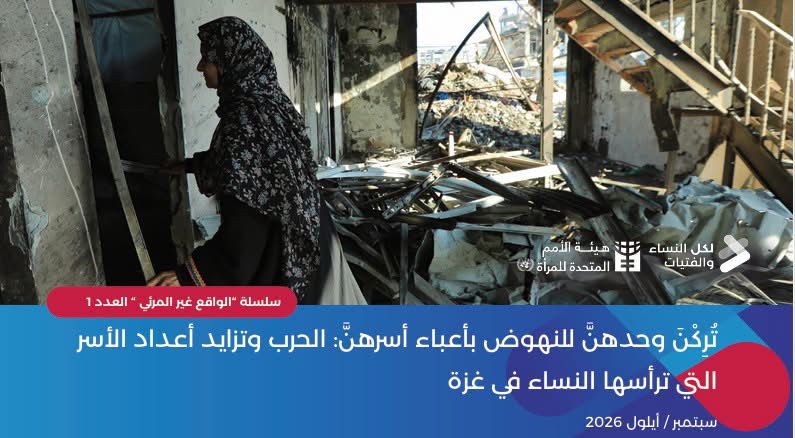
The Ministry of Women’s Affairs: Rising Numbers of Women-Headed Households in Gaza Call for an integrated and comprehensive response which addresses their roles and needs
The Ministry of Women’s Affairs highlighted the importance of the findings of the UN Women report entitled “Shouldering the Burden of Their Families: War and the Rise in Women-Headed Households in Gaza.” The report documents the changing circumstances of women-headed households in the Gaza Strip amid the war and the mounting responsibilities and burdens borne by women.
Published in September 2026, the report indicates that women-headed households have risen to approximately 23% of all households in Gaza—an estimated 86,290 households. This increase compared with pre-war levels reflects a significant transformation in household composition and the distribution of responsibilities within families.
The report shows that women who have shouldered responsibility for their families fulfil multiple roles, including making household decisions, managing resources and income, securing assistance, and caring for children, while confronting exceptionally difficult economic, humanitarian and security conditions. It also reveals that women-headed households face substantial unmet needs, alongside challenges concerning housing, livelihoods, protection and access to services.
Al Khalili emphasized that the changes brought about by the war require a reassessment of response policies to ensure that women receive the support they need.
Minister of Women’s Affairs Ms. Mona Al Khalili stated that the report provides an important reading and perception of the social and economic transformations imposed by the war on Palestinian families in Gaza Strip. The report clearly demonstrates the scale of the responsibilities women have assumed, particularly where the family’s breadwinner has been lost, is absent or is unable to fulfil their responsibilities.
Al Khalili added: “The report’s findings clarify that women who have become heads of their households need assistance that goes beyond an emergency response. They need an integrated response that recognizes their roles and responsibilities, provides protection, legal support, livelihood opportunities and essential services, and ensures their participation in setting priorities and designing programmes that meet their families’ needs.” Alkhalili, added the report reveals women heading their households don’t need assistance as merely an urgent need, but, as a complete response that admits roles and responsibilities and provide protection, legal assistance, livelihoods and basic services that guarantee their full participation in identifying priorities and designing programs that responds to the needs of their families.
She stressed that the next phase requires intensified efforts to improve data collection, registration and assessment mechanisms so that they accurately reflect the circumstances of women-headed households. These efforts must ensure that such households are neither excluded nor have their needs underestimated because of shortcomings in classification, outreach or registration procedures, particularly as the report identified gaps in documenting the roles and responsibilities women undertake within their families.
Al Khalili noted that, within its mandate to coordinate and guide national efforts concerning women’s issues, the Ministry of Women’s Affairs will continue to prioritize the integration of women’s needs into humanitarian responses and recovery plans. It will also work to improve women’s access to protection, services and livelihoods in ways that recognize their primary responsibility for their families and strengthen their resilience and capacity to recover.
Alongside integrated support, the report recommended expanding women’s access to legal services and helping them obtain and the issuance of the necessary documentation and establish their legal status and rights in matters relating to widowhood, custody, guardianship, inheritance and civil identity. It also called for assistance mechanisms that account for caregiving responsibilities, mobility and safety, and for women’s participation in humanitarian response planning and the design of assistance and livelihood programmes.
Related topics
- Alkhalili reviewed the results of the efforts implemented by the Ministry of Women’s Affairs during 2024 – 2026 and identify the priorities of the coming period.
- The Deputy Minister of the Ministry of Women's Affairs, Ms. Buthaina Al Salem, participated in the regional workshop on capacity building for data systems and evidence-based monitoring.
- AlKhalili: International Commitments to Palestinian Women Must Translate into Protection, Accountability and Concrete Action
- The minister of Women’s Affairs meets with the General Secretary of the International Trade Union Confederation and discusses the conditions of Palestinian working women and ways to enhance their rights.
- The minister of Women’s Affairs welcomed the representative of Finland to the State of Palestine and discuss joint cooperation
- Al Khalili and Abu Hamda emphasize the importance of integrated efforts to enhance the resilience and empowerment of women in Qalqilya Governorate.
- The Ministry of Women's Affairs discusses with women's organizations enhancing women's resilience and expanding their participation.
- The Minister of Women's Affairs and the honorable Governor of Qalqilya visit the Ajyal Association for the Care of the Elderly.
- The Ministry of Women's Affairs and the Governor of Qalqilya Governorate meet with local councils in Seniria, Izun Atma, and Beit Amin to discuss their needs and strengthen women's resilience.
- The Ministry of Women's Affairs and "Reform" launch the National Feminist Policy to enhance the resilience of Palestinian women in the context of the occupation.