The Ministry of Women's Affairs and "Reform" launch the National Feminist Policy to enhance the resilience of Palestinian women in the context of the occupation.
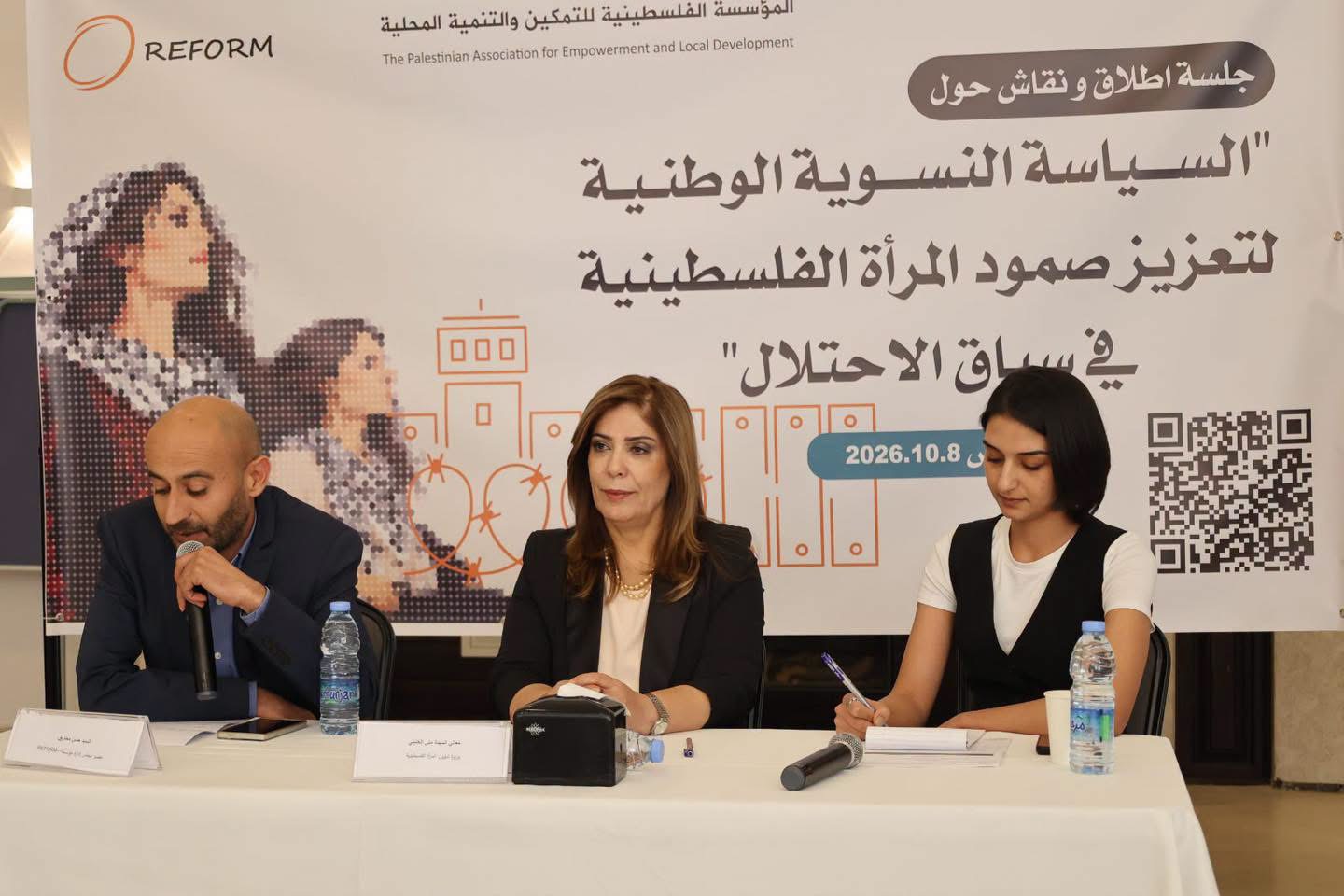
The Ministry of Women’s Affairs and the Palestinian Foundation for Empowerment and Local Development “Reform” launched today the National Feminist Policy to enhance the resilience of Palestinian women in the context of the occupation, during a meeting with the participation of representatives of governmental, national and civil institutions, civil society organizations, experts, feminist activists, and a number of partners and relevant parties.
The minister of Women’s Affairs, Ms. Mona AlKhalili, stressed that the importance of the policy is not limited to being a new document, but rather considered as a framework for joint national action, which aims to move from diagnosing the reality of Palestinian women and the challenges they face to developing practical policies and interventions that are implementable, monitored and evaluated, responding to women’s needs and enhancing their rights and participation in various fields of life.
Al Khalili pointed out that the launch of the policy comes in light of the exceptional circumstances facing the Palestinian people, as a result of the continuation of the Israeli occupation and the repercussions of the war of genocide on Gaza Strip, and the escalation of the occupation’s violations and settler violence in the West Bank, including Jerusalem, and the accompanying humanitarian, social, economic and legal challenges that place double burdens on women and girls, and call for the development of comprehensive and sustainable national responses.
She stressed that the resilience of Palestinian women should not be reduced to their ability to endure crises and adapt to their repercussions, but rather requires providing a political and institutional environment that guarantees their protection and rights, enhances their access to resources, opportunities and services, and their active participation in decision-making, in a way that contributes to addressing the structural causes of discrimination and vulnerability and achieving justice and equality.
Al Khalili explained that the Ministry of Women’s Affairs views enhancing women’s resilience through three interconnected paths, including protection from various forms of violence, discrimination and violations, political, economic, social, legal and technological empowerment, and advocacy and lobbying at the international level, stressing the importance of integrating these paths with existing national strategies and plans, particularly the National Strategy for Justice and Gender Equality 2025–2027, the Third National Action Plan for the implementation of Security Council Resolution 1325 on Women, Peace and Security, and the National Strategy to Combat Violence Against Women 2023–2030.
She stressed that the success of the policy is linked to translating its orientations into clear institutional plans, programs and interventions, supported by budgets, indicators, monitoring, evaluation and accountability mechanisms, and building a sustainable national partnership between the government, civil society institutions and the feminist movement, in a way that enhances the integration of women’s rights and the perspective of gender equality in national policies and plans, and ensures that there is no duplication of efforts and that roles and responsibilities are integrated
For his part, Mr. Hassan Mahariq, representative of the Palestinian Foundation for Empowerment and Local Development “Reform”, appreciated the efforts of the Ministry of Women’s Affairs and the partners in preparing and launching the policy, stressing the importance of partnership in developing a national framework that responds to the reality of Palestinian women and their needs, and contributes to enhancing their participation in public life and decision-making, protecting their rights, confronting discrimination and violence, and supporting the institutional and societal transformations necessary to achieve justice and equality.
Reform Foundation Public Policy Advisor Jihad Harbreviewed the policy’s pillars, priorities, orientations, and proposed interventions, explaining that it is based on a transformative vision of justice and substantive equality, and is based on three integrated levels of change, including direct work with women to enhance their protection and empowerment, developing institutional policies and practices, and creating a transformation in the cultural and societal structures and practices that affect women’s rights and opportunities for participation.
The meeting included an interactive discussion with the participation of Dr. Hanna Nakhleh and Jihad Harb, which addressed the importance of integrating national feminist policy with existing governmental frameworks and strategies, and the need to translate its priorities into institutional interventions that are implementable and measurable, and to promote women’s economic empowerment and political participation, taking into account the specificity of the Palestinian context and the disparity in women’s needs between governorates, especially in light of the occupation, the repercussions of the war, and the current economic and social conditions.
The meeting also included interventions and discussions from participants on ways to enhance partnership between governmental institutions, civil society and the feminist movement, and to develop practical mechanisms for implementing policy priorities and monitoring their impact on the reality of Palestinian women.
The meeting concluded by emphasizing the importance of continuing joint national work to transform policy into implementable and measurable programs and interventions, thereby, enhancing the protection of Palestinian women’s rights, their resilience, and their active participation in public life and decision-making, and consolidating justice and gender equality as an essential part of national policies and the path to building state and societal institutions.
Related topics
- Alkhalili reviewed the results of the efforts implemented by the Ministry of Women’s Affairs during 2024 – 2026 and identify the priorities of the coming period.
- The Deputy Minister of the Ministry of Women's Affairs, Ms. Buthaina Al Salem, participated in the regional workshop on capacity building for data systems and evidence-based monitoring.
- AlKhalili: International Commitments to Palestinian Women Must Translate into Protection, Accountability and Concrete Action
- The minister of Women’s Affairs meets with the General Secretary of the International Trade Union Confederation and discusses the conditions of Palestinian working women and ways to enhance their rights.
- The minister of Women’s Affairs welcomed the representative of Finland to the State of Palestine and discuss joint cooperation
- Al Khalili and Abu Hamda emphasize the importance of integrated efforts to enhance the resilience and empowerment of women in Qalqilya Governorate.
- The Ministry of Women's Affairs discusses with women's organizations enhancing women's resilience and expanding their participation.
- The Minister of Women's Affairs and the honorable Governor of Qalqilya visit the Ajyal Association for the Care of the Elderly.
- The Ministry of Women's Affairs and the Governor of Qalqilya Governorate meet with local councils in Seniria, Izun Atma, and Beit Amin to discuss their needs and strengthen women's resilience.
- The Ministry of Women's Affairs and "Reform" launch the National Feminist Policy to enhance the resilience of Palestinian women in the context of the occupation.