The Deputy Minister of the Ministry of Women's Affairs, Ms. Buthaina Al Salem, participated in the regional workshop on capacity building for data systems and evidence-based monitoring.
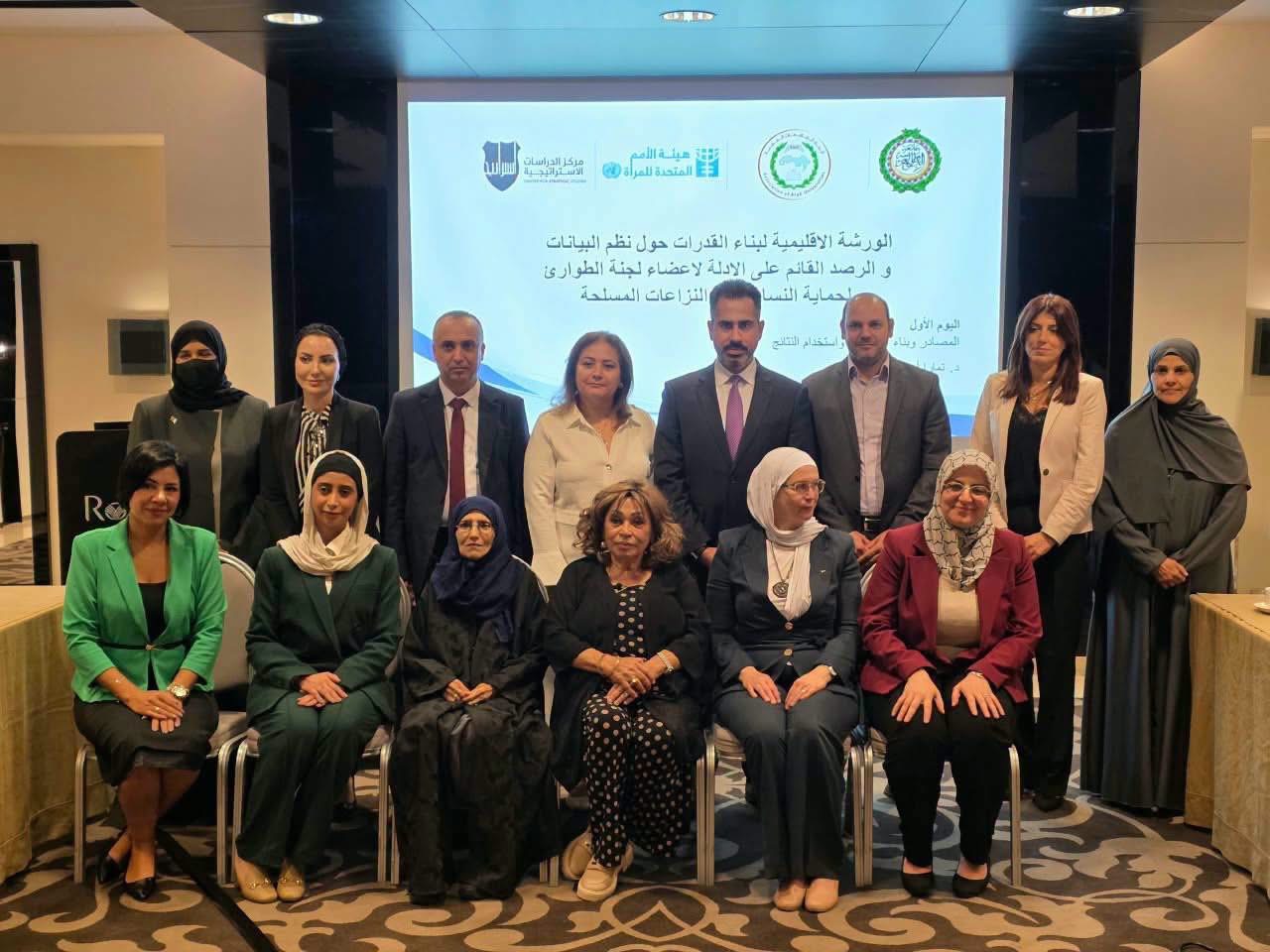
Ms. Buthaina Al Salem, the deputy minister of the Ministry of Women’s Affairs, participated in a regional capacity-building workshop on data systems and evidence-based monitoring for members of the Emergency Committee to protect women during Armed Conflicts. The workshop, held in the Jordanian capital, Amman, was organized by the General Secretariat of the League of Arab States, Social Affairs Sector – Women’s Department, UN Women, and the Association of Arab Universities, through the Center for Research and Strategic Studies at the University of Jordan, with participation from Palestine, Jordan, Egypt, Lebanon, Qatar, Saudi Arabia, Oman and Yemen.
The workshop aimed to strengthen member states capacities to develop and use integrated, evidence-based information systems that support the protection of women in armed conflict, in line with the monitoring and analysis component of the Arab Emergency Committee’s action plan.
The workshop discussed the Emergency Committee’s role in addressing the growing challenges facing women and girls in armed conflict through the development of monitoring and documentation mechanisms, amid existing gaps in the availability of comprehensive and interconnected data on their circumstances. It also examined the limited availability, fragmentation and incompleteness of existing data, and the resulting challenges for decision-makers in designing policies and developing appropriate crisis responses.
Over two days, the training covered a scientific methodology for designing a monitoring system to protect women and girls in armed conflict. This included planning and data collection in accordance with ethical and humanitarian standards and safeguards, data validation and analysis, and secure data sharing within a governance framework, culminating in the use of monitoring findings to inform decision-making, follow-up and the identification of gaps.
In this context, Ms. Buthaina Al Salem, the Deputy minister of the Ministry of Women’s Affairs, presented the State of Palestine’s experience in launching the National Observatory on Violence against Women. She outlined the rationale for its establishment, its importance, and the stages of its development and implementation as a national monitoring tool responsive to the particular realities of Palestine under occupation. She also highlighted the Observatory’s strategic value in providing a national, evidence-based database that contributes to the development of national policies and strategic directions, strengthens coordination and follow-up, and supports the Ministry’s efforts to monitor and respond to violence against wome
Related topics
- Alkhalili reviewed the results of the efforts implemented by the Ministry of Women’s Affairs during 2024 – 2026 and identify the priorities of the coming period.
- The Deputy Minister of the Ministry of Women's Affairs, Ms. Buthaina Al Salem, participated in the regional workshop on capacity building for data systems and evidence-based monitoring.
- AlKhalili: International Commitments to Palestinian Women Must Translate into Protection, Accountability and Concrete Action
- The minister of Women’s Affairs meets with the General Secretary of the International Trade Union Confederation and discusses the conditions of Palestinian working women and ways to enhance their rights.
- The minister of Women’s Affairs welcomed the representative of Finland to the State of Palestine and discuss joint cooperation
- Al Khalili and Abu Hamda emphasize the importance of integrated efforts to enhance the resilience and empowerment of women in Qalqilya Governorate.
- The Ministry of Women's Affairs discusses with women's organizations enhancing women's resilience and expanding their participation.
- The Minister of Women's Affairs and the honorable Governor of Qalqilya visit the Ajyal Association for the Care of the Elderly.
- The Ministry of Women's Affairs and the Governor of Qalqilya Governorate meet with local councils in Seniria, Izun Atma, and Beit Amin to discuss their needs and strengthen women's resilience.
- The Ministry of Women's Affairs and "Reform" launch the National Feminist Policy to enhance the resilience of Palestinian women in the context of the occupation.